Every kitchen has one. The cabinet or drawer where food storage containers go to fight each other for space, where lids never match bodies, and where opening the door is a small act of bravery because something always falls out. If yours is at peace, you are an unusual person living in an unusual home. For the rest of us, this guide.
Solving the Tupperware problem is not about willpower or about owning fewer containers (although both help). It is about three small decisions: which containers to keep, how to store them, and the one rule that prevents the chaos from coming back.
Why It Always Falls Apart
Food storage containers have a unique failure mode. Every other category of kitchen item has a clear function — a knife cuts, a bowl holds food, a pan cooks. Containers have a function that depends on a partner (the matching lid), and partners get separated constantly because they go through the dishwasher at different times, get put away by different people, and accumulate over years from different sets.
By the time most kitchens reach mid-life, the container cabinet contains a slow-grown stockpile of mismatched survivors from at least three sets, plus takeout containers, plus the gift set someone bought you, plus the cake tin from a birthday party two years ago. No system can survive that variety. Step one is reducing the variety.
Step One: The Great Sort
Take every container and every lid out of the cabinet. Set them on the counter or floor in two piles: bodies and lids. Match every body with its lid. Anything without a partner goes in a box labeled 'orphans.'
For the orphans, give yourself one week. Anything that finds its match in the dishwasher over the week gets reunited. Anything still single after a week gets recycled (most rigid plastic and glass is recyclable; check your local rules). Be ruthless. An orphan lid that has been single for six months is unlikely to find its container behind the toaster.
Step Two: Pick One Set
Now look at what you have left. Almost certainly you have a mix of brands, materials, and sizes that cannot stack cleanly together. The single biggest improvement to a container cabinet is committing to one matching set in a few sizes.
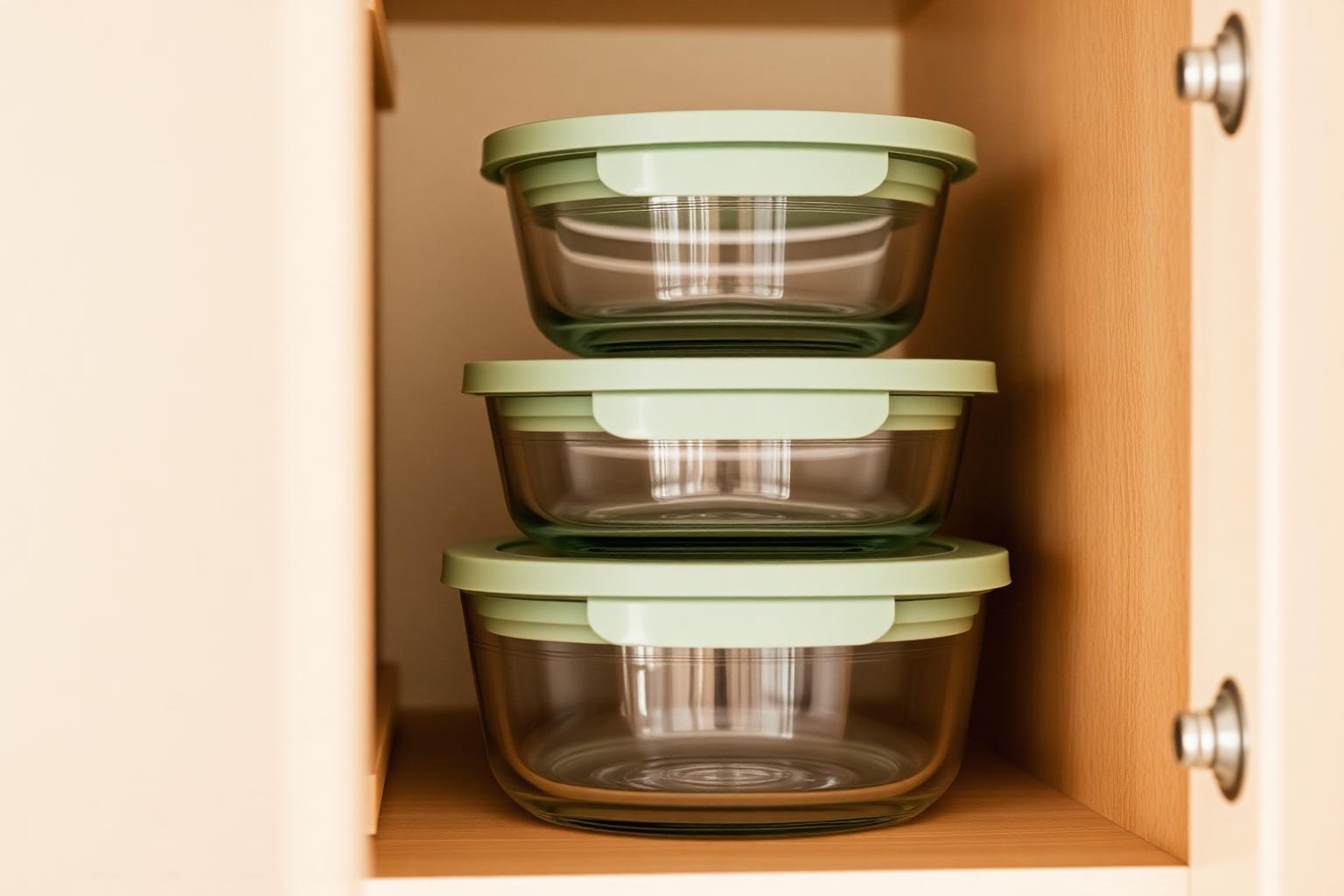
Glass with snap-on lids is the gold standard. The set costs more upfront but lasts decades, does not stain or warp, is microwave and oven safe, and looks calm in the cabinet. A starter set of 8 to 10 containers in three sizes runs about 60 dollars and replaces 30 mismatched plastic ones.
Plastic is fine if you want lighter or cheaper. Just commit to one brand, one shape (square stacks better than round), and one lid style.
Step Three: Reduce the Count
Most kitchens need fewer containers than they own. A working set looks something like this:
- Three large (for big batches of soup or pasta)
- Four medium (for leftovers of single meals)
- Six small (for lunches, kids' snacks, sauces)
- Two extra-small (for nut butters, single servings)
That is 15 containers, total. If you regularly have a fridge full of more leftovers than that, you have a different problem worth thinking about separately.
Step Four: The Storage Method
Now the actual organizing. Two parts: bodies and lids.
Bodies stack neatly because you committed to one set. Stack them by size in nested towers. Each size in its own tower means you can grab the size you need without moving the others.
Lids are the harder problem. Do not stack lids on top of their containers — it triples the height of the stack and is the single biggest reason container cabinets fall apart. Instead, store lids vertically in a separate divider. A thin cardboard box, a magazine file, or a dedicated lid organizer all work. The point is that every lid stands on its edge so you can see and grab any of them in one motion.
Step Five: Pick the Right Cabinet
Containers do not need to live in the most accessible cabinet in the kitchen. Put them in a lower cabinet, ideally a deep drawer near the dishwasher (so emptying the dishwasher takes one motion), or in a cabinet that is otherwise underused. The cabinet over the microwave is often a good spot — annoying to use for dishes, fine for containers because you reach for them less often than plates.
The One Rule
Here is the rule that prevents the chaos from creeping back: every container must be put away with its lid. Either snap the lid on, or store the lid in the lid organizer the moment the container goes in the cabinet. Never let bodies and lids drift apart even briefly.
Most household members will need a reminder for the first month. After that the rule becomes automatic.
The One-In-One-Out Policy
When you buy a new container set, give away or recycle an equivalent number of old ones. Without this rule, your collection slowly grows back to the chaos you started with. With it, the cabinet stays at the size you decided was right for your family.
The container cabinet is the one part of the kitchen where ruthlessness pays off most. Every container you do not own is a container that cannot become an orphan.
Glass vs. Plastic: A Quick Honest Comparison
Glass: heavier, more expensive, lasts forever, microwave and oven safe, does not stain, does not absorb smells, lids tend to crack before bodies do.
Plastic: lighter, cheaper, easier for kids, warps in the dishwasher over years, stains from tomato-based sauces, lids tend to outlast bodies.
Best move for most households: a starter set of glass for adult meal storage, plus a small number of light plastic for kids' lunches and freezer overflow. Two materials, both committed to single brands and shapes.
Takeout Containers
Restaurant takeout containers are usually pretty good food storage. The catch: they multiply silently, take up space, and never match anything. Keep five of the best ones (any more is excess) and recycle the rest as they come in.
The Quarterly Audit
Every three months, open the container cabinet and do a thirty-second scan. Any orphan lids? Match or recycle. Any cracked containers? Toss. Any leaning tower of disorder forming? Restack. Thirty seconds, four times a year, is the entire maintenance.
Final Thoughts
The Tupperware drawer is the smallest organizing project in the kitchen and the one with the biggest emotional payoff. Reaching into the cabinet, grabbing a body, grabbing a lid that fits it the first time, and closing the cabinet without anything falling out — those four motions, repeated daily for a year, are quietly the difference between a kitchen that feels stressful and a kitchen that feels solved.
Filed in Organizing · Pantry & Kitchen
More articles