Open any home design magazine to the closet feature and you will see the same thing: a 200-square-foot walk-in with an island in the middle, drawer dividers from a Scandinavian brand, and a chandelier. It is beautiful, and it is irrelevant to almost everyone reading this. Most American closets are six feet wide, three feet deep, and serve two adults' worth of clothes. The rest of the world's closets are even smaller.
This guide is for that closet. The one in the master bedroom of a normal apartment or a starter home. The one you cannot expand, cannot redesign without permission, and cannot pretend is twice its size. The closet you actually live with. There are real solutions that work in this scale, and almost none of them appear in the magazines.
Start by Mapping the Vertical Space
Most regular closets have one or two horizontal rods and one shelf above them. That is it. The vertical space above the shelf is almost always wasted, and so is the vertical space below the rod. Reclaiming both is the single biggest improvement you can make.
Measure the closet from floor to ceiling. Note where the existing rods and shelves are. You will use this information to add a second tier of hanging space, a stacked shelving unit above the high shelf, or a small dresser at the bottom — possibly all three.
Step One: Double the Hanging
Half your clothes are probably short-hanging items: shirts, blouses, folded pants over hangers. None of them need 60 inches of vertical hanging space. Install a second tension rod or a clip-on hanging rod (no installation required) about 36 inches below the existing rod. Suddenly half the closet has two tiers, doubling the hanging capacity without touching the walls.
Reserve one full-height section for long items — dresses, coats, jumpsuits. The rest goes on the doubled-up tier.
Step Two: Reclaim the High Shelf
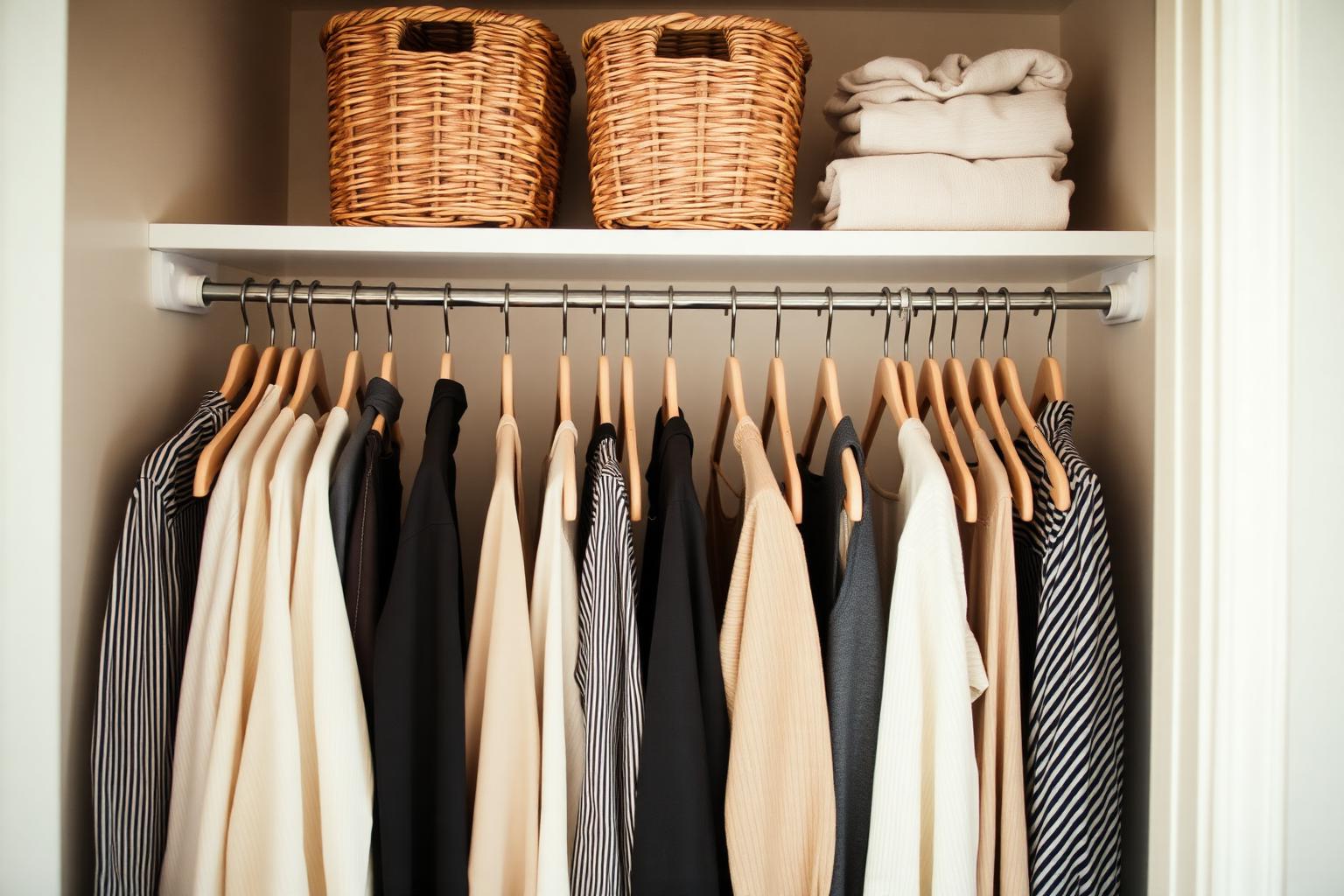
The high shelf in most closets is a wasteland of duffel bags and one rarely-used sleeping bag. It has more potential than that. Add a tiered shelf insert (cheap wire ones work fine) to subdivide the vertical space, then store off-season clothes in labeled cloth bins. Each bin sits on the shelf, lifts down with a small tug on a handle, and brings the off-season swap from a 40-minute project to a 10-minute one.
Label each bin clearly: winter sweaters, summer dresses, beach gear. The label faces out so you do not have to remember what is in which bin a year later.
Step Three: Reclaim the Floor
The floor of most closets has shoes scattered across it, plus the things that have no other home. Either of two solutions works.
Option A: a small dresser at the bottom of the closet for folded items (jeans, sweatshirts, t-shirts), with shoes on top of the dresser in pairs. This works if your closet is at least 24 inches deep.
Option B: a tall narrow shoe rack on one side, paired with a couple of stacked storage cubes on the other. This works in shallower closets and tends to be more flexible.
Either way, the floor itself should be clear enough to vacuum without moving anything.
Step Four: The Inside of the Door
The inside of the closet door is another usually-wasted surface. Three good uses:
- An over-the-door shoe organizer (works for far more than shoes — handbags, scarves, hats, beauty supplies)
- A full-length mirror
- A row of hooks for tomorrow's outfit or the jacket you wear daily
Each option costs under 30 dollars and adds meaningful function to a surface that otherwise just opens and closes.
Step Five: The Hanger Decision
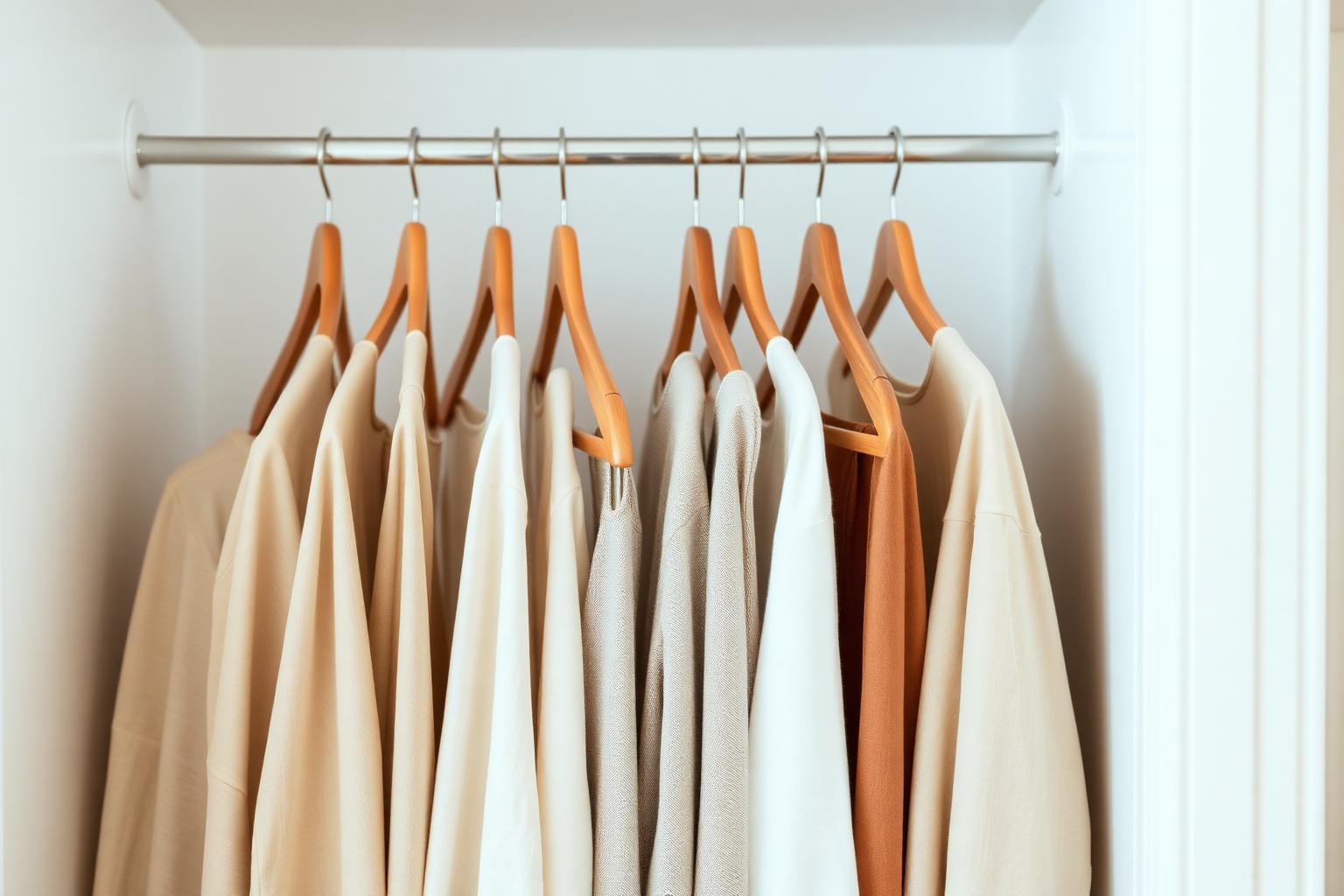
Mixing hanger types is the visual equivalent of mixing fonts in a document. Switch to one type and one color of hanger throughout the closet. The effect is dramatically calmer and also gives you slightly more hanging space because matching hangers pack tighter.
The cheap velvet hangers work well for almost everything (they grip clothes so things do not slide off and they are thin) and cost about 30 dollars for 50. Wooden hangers look nicer but take more space and cost more. Plastic tubular hangers from the dry cleaner should go in the recycling.
Step Six: Folding That Saves Space
Vertical folding — the method made famous by Marie Kondo — saves a remarkable amount of drawer space and makes every item visible at a glance. Fold each garment into a small rectangle that stands on its end, file-folder style, in the drawer. T-shirts, jeans, sweaters, and most casual wear all fold this way.
It feels strange the first time. By the second or third week it is faster than stacking, because you can see every item without moving any of them.
The 80/20 Rule of Closets
Most people wear 20 percent of their clothes 80 percent of the time. Make sure that 20 percent is in the most reachable spots — eye level, front of the closet, easiest hangers to grab. Move the 80 percent of less-worn items to less prime real estate: the high shelf, the back of the rod, the bottom drawer of the dresser.
This single shift, with no additions or removals, makes the closet feel half its previous size of effort to use.
What to Move Out of the Bedroom Closet Entirely
Some things almost always end up in bedroom closets and do not belong there. Move these out and the closet feels twice as spacious:
- Cleaning supplies (move to the laundry room or under a sink)
- Old papers and tax documents (move to a file box in another room)
- Random household tools (move to a utility closet or kitchen drawer)
- Gift wrapping supplies (move to a labeled box in the linen closet)
A small closet is not the problem. A small closet trying to do nine jobs at once is.
When You Truly Cannot Add Anything
If you rent and cannot install rods, use brackets, or even adhesive hooks, you still have options. A free-standing garment rack from any home store costs about 40 dollars and adds 30 inches of hanging space anywhere there is a wall. Under-bed storage bins handle off-season clothes. A small dresser anywhere in the bedroom takes the load off the closet entirely.
These are not workarounds. They are how most people in cities live, and they are fine.
A Note on Off-Season Storage
Off-season clothing should not be in the bedroom closet at all. Move it to a hall closet, an under-bed bin, or a vacuum-sealed bag on the high shelf. The bedroom closet should contain only the current season plus the small set of year-round basics. This single rule frees up about 40 percent of most closets.
Maintenance
Closets need a real reset every change of season — about 20 minutes, twice a year. Pull out the season ending. Put away the season beginning. Donate anything you did not wear last year. Those two annual sessions are the entire maintenance for a closet built around the principles above.
Final Thoughts
A small closet is not a design problem. It is a constraint, and constraints, used well, force you to be honest about what you own and how you use it. Add a second rod, reclaim the high shelf, use the door, switch your hangers, fold vertically, and remove the 20 percent of items that do not belong in there at all. None of those moves require permission or a renovation. All of them, together, make a six-foot closet feel like a much larger one. The walk-in chandelier closet is overrated anyway.
Filed in Organizing · Closet & Bedroom
More articles